
All five instances updated, no leftover first-person pronouns, and it’s still clean on banned words and dashes.
Design leadership in a changing world: strategy, value and AI
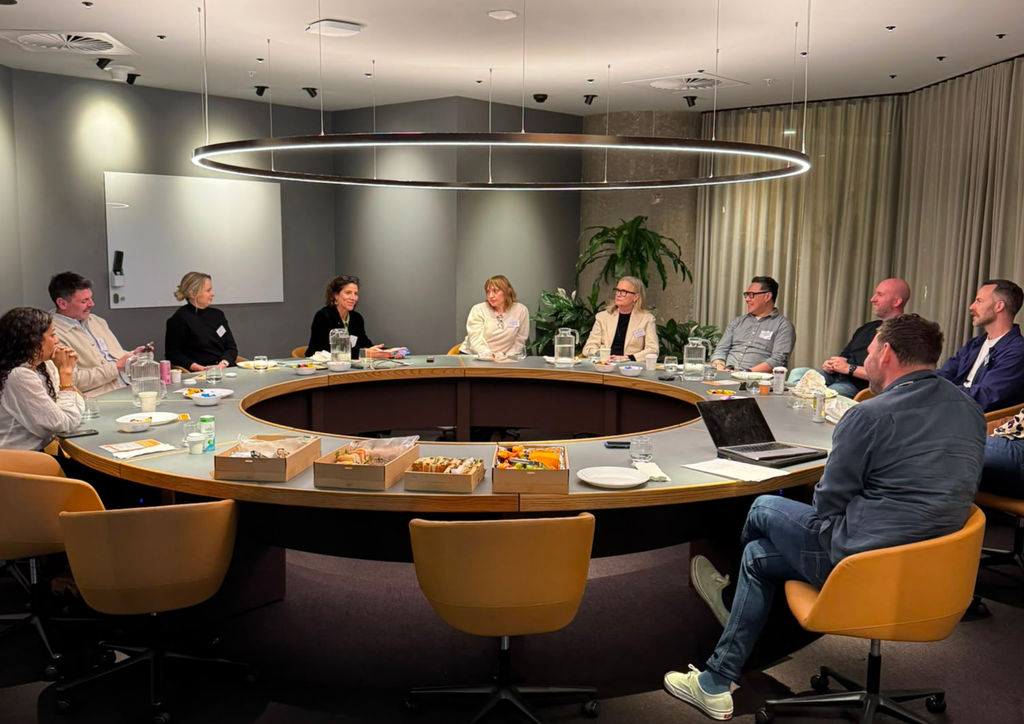
In August, Liam brought together a group of senior design leaders for a round table exploring three topics that are becoming increasingly difficult to separate:
How does design become a stronger strategic and commercial partner? How do we better demonstrate the value of design? And what does the future of the designer, and the design team, look like in an AI-driven world?
We covered a lot of ground, and what became clear early on was that these aren’t three separate conversations.
AI is accelerating production, lowering the barriers for non-designers to create credible experiences, and blurring the boundaries between design, product and engineering. At the same time, organisations are under pressure to move faster, operate more efficiently and demonstrate clearer commercial returns from their investments.
Put those things together and some fairly fundamental questions emerge about the future of design. Where should designers spend their time? What should they stop owning? What remains uniquely valuable about design when more people can “design”? And how do we develop the next generation of designers when AI begins removing some of the work through which previous generations developed their craft?
Here are the biggest themes that emerged from the conversation.
Maybe we need to stop talking so much about design
For years, the design industry has talked about getting a seat at the table. An interesting challenge came up during the discussion: does continually advocating for design as a separate discipline reinforce the problem? Perhaps design creates greater influence when it stops trying to demonstrate its individual contribution and instead focuses on enabling everyone around it.
If design makes product better, engineering better, strategy better and ultimately creates better customer and business outcomes, its value becomes embedded in the organisation rather than something that constantly needs to be defended. It changes the conversation from how do we prove the value of design, to how do we help the organisation create better outcomes. It’s a subtle distinction, but an important one.
If we want to be strategic, we need to understand business strategy
Designers have talked for years about wanting to move further upstream, but design strategy and business strategy aren’t necessarily the same thing.
To participate meaningfully in commercial and strategic conversations, designers need to understand what the organisation is trying to achieve: how the business creates value, what metrics matter, where investment is being made and how the work we’re doing contributes to those outcomes.
That shifts the framing from “here’s why this is a better experience” to “here’s the customer and business outcome we’re trying to change, and here’s how this experience contributes to it.”
One practical example discussed was building those questions directly into design critiques. Before showing the design, designers, including juniors, are encouraged to articulate the problem, the business objective, whether they’re solving the right problem, and the outcome they’re hoping to influence. Only then do they talk about the design.
It’s a simple change, but it raises an important point: commercial thinking shouldn’t suddenly become relevant when someone becomes a Head of Design. It can be developed throughout a designer’s career.
Different designers bring different strengths
There was an equally important counterpoint. The future designer doesn’t need to be some kind of superhuman combination of designer, engineer, product manager, strategist and commercial operator. Some designers naturally gravitate towards strategy, ambiguity, stakeholder influence and commercial thinking. Others are exceptional at craft, interaction, systems and detailed problem-solving. We need both.
The leadership challenge is less about creating one definition of the future designer and more about building teams containing complementary capabilities.
One analogy used in the conversation was a cricket team: you don’t want eleven identical all-rounders; you need specialists, different strengths, and enough people capable of connecting those strengths together.
As the boundaries between disciplines become more fluid, team design may become more important than job design.
Are we measuring speed to design, or speed to value?
This was one of the more interesting debates of the session. There is understandably increasing pressure to quantify design productivity, but isolated measures such as time-to-design can create the wrong behaviours.
A designer might spend longer on something because they’ve challenged the brief, uncovered an important customer problem, aligned conflicting stakeholders or stopped the organisation from building the wrong thing. Through a narrow productivity lens, they may appear inefficient.
Commercially, they may have created enormous value. So the more useful question may be less about how quickly we designed something, and more about how quickly we got to the right outcome.
There was an important counterpoint here too: designers also need to recognise that time costs money. Craft can become perfectionism, and another week polishing something is another week that can’t be spent solving another problem. Speed still matters. The real question is what level of investment the value and risk of the problem justifies.
Matching design effort to the size of the problem
This led into a substantial conversation about design pragmatism versus design purity. Designers are often taught a methodology: discovery, research, synthesis, journey mapping, design, testing. But not every problem warrants the same investment. Sometimes six weeks of research is entirely appropriate. Sometimes it isn’t.
A useful question raised was how big is the prize, and therefore how much design effort the problem justifies.
Good research and process still matter here. The point is judgment: knowing which parts of the process to use, when to use them, and why.
Interestingly, some leaders described the opposite challenge: experienced teams moving too quickly because they believe they already understand the problem. Sometimes we need to accelerate. Sometimes we need to slow down. Knowing the difference is the skill.
The real measure is whether it worked
Another challenge raised was what happens after something goes live. Too often the process looks like discovery, build, MVP, launch, next initiative, when the missing question is whether it worked.
MVP was originally about experimentation and learning, but in some environments MVP has become shorthand for getting something out the door before moving on to the next priority. That risks creating organisations full of partially solved customer problems that are rarely revisited.
The discussion explored moving the model towards something closer to hypothesis, build, release, evidence, outcome, learning, iteration.
One particularly interesting idea was connecting customer journey maps with operational, behavioural, experience and business data. Rather than a journey map remaining a static design artefact, it potentially becomes a living performance dashboard showing where the experience is working, where customers are struggling and where intervention could create the greatest value. That’s a very different relationship between design and commercial performance.
These challenges existed before AI
Then, inevitably, we got onto AI. One of the more important points was that many of the challenges we’re now discussing aren’t new. Design already struggled with getting upstream. We already struggled with proving commercial value.
Organisations already struggled with knowledge management. Product, design, and engineering have already struggled with handoffs, and teams have struggled to close the loop between shipping something and understanding whether it worked.
AI didn’t create those problems. It accelerates the environment in which they exist. If the underlying system is strong, AI can make it dramatically more effective. If it isn’t, we may become capable of producing the wrong things much faster.
Why understanding still needs the messy work
One of the most thought-provoking parts of the discussion was AI’s potential role as an organisational memory. Imagine an AI-enabled knowledge layer containing research, customer interviews, transcripts, product knowledge, design systems, documentation and business context.
The potential is enormous, and teams could stop continually rediscovering things the organisation already knows.
But there’s another side to it. If AI reads all the transcripts, synthesises the research and presents the insights, has the designer understood the problem?
Historically, some of that messy work was part of how designers developed intuition and judgment: reading the interviews, finding the patterns, sitting with contradictory evidence, working through the ambiguity. AI can remove a lot of that work. The question is whether we’re sometimes removing the thinking embedded within it as well.
That creates an important challenge for design leaders: what should we automate, and what do humans still need to experience themselves in order to develop understanding and judgment?
Where should we spend our human hours?
This was probably one of Liam’s favourite questions from the discussion. As AI reduces the cost of producing things, we need to become more deliberate about where we invest human attention, and where we spend human hours versus machine hours.
A high-value, ambiguous or strategically important problem might justify deep research, experienced designers and significant human judgment. Routine, lower-risk work might increasingly be AI-assisted, system-generated or created by adjacent disciplines with appropriate design guardrails. It means matching human investment to the value and complexity of the problem.
What happens when everyone can design?
AI is also making traditional role boundaries increasingly porous. A product manager can prototype. A designer can work directly with code. An engineer can create an experience. The traditional sequence of product, design, engineering starts to become less clear, and instead we may see tighter loops where product, design and engineering bring different expertise throughout the lifecycle.
That creates an interesting challenge for design. If other people can increasingly produce credible design work, do designers protect ownership of production, or do we enable the broader organisation to make better design decisions at scale? That could mean designers spending more time creating the systems, guardrails, principles, knowledge and context that allow others to produce good experiences, while concentrating their own attention on the highest-value and most complex problems.
There was an important warning here too: design can’t become the team that checks everything at the end. If our future role is checking whether the buttons are right, we’ve moved further downstream, not further upstream.
The junior designer question worries Liam more than the senior designer question
Perhaps the biggest unanswered question was what all of this means for people entering the profession. Senior designers spent years doing repetitive work that AI may increasingly automate. Not all of it was particularly exciting, but through that work they developed pattern recognition, craft, intuition, technical understanding and judgment. Eventually, those thousands of smaller decisions gave them the experience to make much bigger ones.
AI potentially removes some of that apprenticeship layer. For an experienced designer, AI can be an incredible accelerator because they’re applying it on top of years of existing judgment. But how does someone graduating today develop ten years of judgment without doing the work through which previous generations acquired it?
There wasn’t a neat answer in the room, but it feels like an increasingly important responsibility for design leaders: we may need to deliberately create learning experiences that previously happened naturally through work.
From designing products to designing the environment
One of the most tangible examples discussed was an AI-enabled internal environment connecting AI, real code, design systems, organisational knowledge, brand rules, documentation and components. Rather than creating a prototype that gets thrown over the fence and rebuilt, product, design and engineering can work much closer to the actual product environment.
The interesting part goes beyond making teams faster: it potentially changes what designers design. Instead of asking why is an engineer doing design, the question becomes how do we improve the system so that when anyone designs something, the system helps them make better decisions. That’s a fascinating shift. Designers aren’t only designing the output. They’re increasingly helping to design the environment that creates the output.
So what does the future designer look like?
Liam doesn’t think the conclusion from the discussion was that the future designer is a designer who knows AI.
If anything, many of the capabilities discussed were distinctly human: judgment, sense-making, commercial understanding, deep craft, curiosity, humility, comfort with ambiguity, the ability to collaborate across disciplines, and the ability to understand when technology should accelerate something and when a human needs to slow down and think.
AI changes what we can produce and how quickly we can produce it. But the more interesting question for design may be what becomes more valuable when making things becomes easier.
The discussion didn’t produce one definitive answer, but it certainly gave us plenty to think about, and it’s exactly the conversation design leaders need to be having.
If you’d like to join the conversation at the next Leadership Round Table, get in touch with Liam directly at [email protected] and he’ll add you to the list.


